27 June 2026
Debt Collection in Australia
Find out information about how to recover debts in Australia from our team of company formation agents in Australia.
Our company formation agents in Australia can provide you with information about how debt collection is performed here. Of course, our team can also provide the necessary legal support in any type of debt collection formalities.
What rules of law regulate debt collection in Australia?
In the list below, our consultants in company formation in Australia invite you to discover the legal framework that establishes how debt collection can be completed here:
- the Competition and Consumer Act 2010 and the Australian Consumer Law;
- the Australian Securities and Investments Commission Act 2001, Part 2, Division 2;
- the National Consumer Credit Protection Act 2009 and the National Credit Code;
- the Bankruptcy Act 1966.
| Quick Facts | |
|---|---|
| Laws on debt collection | The Australian Consumer Law, the Competition and Consumer Act, the Bankruptcy Act, local laws applicable in each Australian state and territory. |
Amicable settlement available (yes/no) | Yes |
Who can collect debts in Australia? | Debt collection in Australia is done by debt collection agents. |
| Code of Conduct for debt collectors | The Debt Collection Guidelines for Collectors and Creditors. |
| Asset seizure – types of assets that can be seized from debtors | Provided that debt collection in Australia is not concluded with the collection of debts, debtors can have their assets seized. Such as can refer to cash, bank account deposits, real estate, vehicles, etc. |
| Overseas debt collection (yes/no) | Yes |
| Rules for overseas debt collection | Debt collection involving debtors overseas must be done in accordance with the rules applicable in the location where the debtor currently resides. |
| Court proceedings for debt collection (yes/no) | Yes |
| Court responsible in hearing debt collection cases | District Court, Magistrates Court. |
| Debt thresholds required to address the court | They are established at the level of each Australian state and territory. |
| How is debt collection initiated? | The debt collector contacts the debtor and informs him/her on the existence of the debts and the new deadline to make the payment. |
| Period of time to file a defense | It depends on the court rules (usually 21 to 28 days after the claim is served). |
| Responsibilities of debt collectors | Debt collectors can inform on the current debt, provide advice on the most suitable course of action, contact the debtor via telephone or in person (however, only in certain conditions), offering information on the consequences of not making the payment, etc. |
| Actions that debt collectors are prohibited to take against debtors | – can’t mislead the debtor; – can’t harass him or her; – can’t take advantage of the debtor’s situation; – can’t use physical force; – can’t contact via telephone at any given hour or more than several times in a given period; – can’t arrive at the person’s premises (commercial or residential) unannounced. |
| Legal services on debt collection offered by our lawyers | Our services for debt collection in Australia are designed for debtors and creditors alike. We can help individuals, companies, non-profit organizations in various debt collection procedures. Of course, we also offer legal representation in front of competent courts. |
Are there any differences between debt collection procedures based on the states/territories?
Yes. While Australia has rules of law that apply at a national, federal level, it must be noted that differences can appear in legislation and procedures from one state/territory to another. At a national level, debt collection in Australia falls under the provisions of the laws we have presented above. However, in specific matters, different policies and procedures can apply.
Who can recover debts in Australia?
Any individuals, companies, organizations that have provided a service, a product, etc., to another party (regardless of its nature) that has not fulfilled its financial obligations towards the other party.
What are the main ways through which I can initiate debt collection in Australia?
Individuals and companies that must recover a debt have several options in this sense. They can:
- address friendly reminders (usually, via e-mail);
- start informal negotiations;
- send a letter of demand.
What is the content of a letter of demand?
A letter of demand is one of the main formal ways through which a party can address a debtor, by informing the latter on the amount due and the conditions in which the debt can be recovered. Some of the main elements are:
- the identification data of the entity sending the letter of demand (in cases of companies, they need to present their trade name, the Australian Business Number/Company Number, the business address);
- the information of the debtor;
- the sum of money that make the object of the letter;
- the service/product and the date at which it was purchased;
- a copy of the invoice for the respective product or service;
- details regarding the date when the debt should be paid and the means of payment;
- the deadline to comply with the requirements of the letter of demand;
- the actions that can be taken against the debtor.
How do debt collectors get in touch with the debtor?
Communication is the key for a proper recovery of debts in Australia, and a debt collection agent will initiate the amicable procedure in this sense, by contacting the company and by following these steps:
- the debtor is informed about the current payments he/she needs to take care of;
- details about legal aspects involved (if the payments are not respected in due time) can be offered or reminded;
- new payment terms and arrangements can be established between the parties involved;
- if an alternative payment is available, the conditions for this method can be proposed.
When can one get in touch with a debtor in Australia?
In the list below, our specialists in company incorporation in Australia present you what constitutes reasonable hours of contact, based on the manner in which the debt collector contacts the debtor:
- provided that the debt collector addresses the debtor by telephone, he or she can call starting from 7:30 AM, and no later than 9 PM, as long as the calls are made during business days (Monday to Friday);
- the debt collector can also call during weekends, but the call hours are between 9 AM and 9 PM;
- when addressing the debtor in person, the debt collector can arrive at the premises of the debtor between 9 AM and 9 PM throughout the entire week;
- for business in-person meetings, the debtor can go to the company’s premises during the company’s regular working hours and during weekends, from 9 AM to 5 PM.
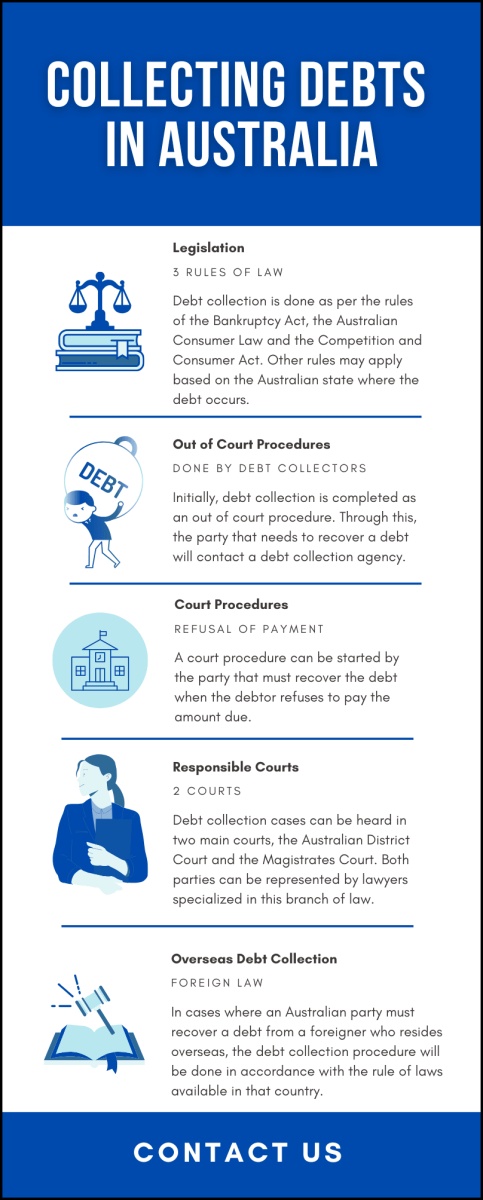
We invite you to read our infographic on collecting debts in Australia:
Can I recover debts through the courts in Australia?
The debt collection in Australia can be concluded through the procedures made in the court of law in this country. The procedural rules and the territory law are at the base of the debt recovery procedures in Australia.
What are the limitations periods in court debt collection cases?
In the case of debt collection situations that are brought in front of courts, it must be noted that the limitation periods are 6 years for debt claims in most states (3 years in the Northern Territory), while 12 years apply to enforcing judgments in the majority of the Australian states or 15 years (in Victoria and South Australia).
What is a limitation period?
It refers to the maximum amount of time in which a case can be disputed between parties, whether it is through out-of-court or court formalities. Once the limitation period expires it means that the contractual conflict will not be resolved, as legal action can’t be taken anymore (the situation is known as statute barred).
We invite you to contact our consultants in company incorporation in Australia for corporate services, which also include tax advice, compliance, accounting, mergers and acquisitions, reorganization and debt collection in Australia.