15 June 2026
Chartered Accountants in Australia
Our accountant in Australia can present the accounting procedures necessary for your local or foreign business operating here.

If you need specialized accounting services, we invite you to address our chartered accountants in Australia, who have the necessary qualifications to assist the needs of all types of entities.
What are chartered accountants?
Chartered accountants in Australia are persons who have obtained a higher level of qualification in the accounting profession. Thus, not all accountants are qualified as chartered accountants and those who have not yet applied for this qualification can develop only certain types of accounting activities, mainly basic.
| Quick Facts | |
|---|---|
| What is a chartered accountant | A chartered accountant is a person who has gained a high level of qualifications in the field of accounting and who can provide assistance in other related matters, such as business consultancy, management. The accountant has an in-depth experience in the field. |
| Types of services provided by chartered accountants | Forensic accounting, bookeeping, audit, financial planning, business advice, reporting, assistance in corporate restructuring, etc. |
Record-keeping rules for sole traders in Australia | Income Tax Assessment Act 1936 (s 262A record keeping); income is reported in the individual tax return |
| Types of annual accounts | General purpose financial statements (Tier 1 or Tier 2 – Simplified Disclosures) and consolidated financial statements |
| Institutions that can use the services of chartered accountants | Both public institutions and private entities (commercial, non-profit). |
| Accounting services for public institutions | Audit, valuation, financial advice, tax services, reporting, basic accounting procedures, insolvency, etc. |
| Institution that regulates the activity | Persons working in this industry must abide by the rules of the Chartered Accountants Australia and New Zealand. |
| Minimum qualification for becoming a chartered accountant | Have a bachelor degree in fields related to accounting, have sufficient work experience in accepted fields (tax, accounting, finance, etc.), obtain a provisional approval from the Chartered Accountants Australia and New Zealand. |
| Foreign accountants allowed to work in Australia (yes/no) | Yes |
| Minimum requirements imposed to foreign accountants | They must comply with the same regulations imposed to local chartered accountants. Besides these, they have to provide evidence on knowing the English language (IELTS 6.5 or IELTS 7 for those who have been accepted on a permanent migration assesment) and have a suitable visa. |
| Providing management services (yes/no) | Yes |
| Types of management services | Management services designed for the needs of a business (a start-up, a developing business or a well-established company), which aim at the development of the business, the strategy to apply on a given market, the most effective ways to budget the business, etc.). |
| Accounting services for companies | Bookkeeping, GST reporting, tax compliance, preparing tax reports, payroll services, and other services, depending on the needs of the company. |
| Submitting tax returns (yes/no) | Yes |
| Basic payroll services | Calculating the wages of the employees, the taxes associated with their employment contracts, submitting the taxes due, etc. |
| Difference between an accountant and a chartered accountant | A chartered accountant is a member of Chartered Accountants Australia and New Zealand (CA ANZ) and he or she has top level knowledge in the field. The chartered accountant can offer his or her services to the top management structure of a company, by presenting the most suitable ways to invest/expand/strategize, etc. Other qualified accountants (e.g. CPA Australia or IPA members) can provide such services too. |
| Law regulating the activity of chartered accountants in Australia | The internal regulations of the Chartered Accountants Australia and New Zealand, the CA ANZ Professional Standards Scheme (new scheme in force since 13 July 2025). |
What services can chartered accountants in Australia provide?
According to the Australian accounting standards, chartered accountants can provide basically any type of accounting service that is regulated under the local law. Below, you can find out some of the services that chartered accountants in Australia can offer:
- audit services – the audit is required for certain types of companies, and it refers to the procedure through which the company’s yearly financial reports are reviewed by a specialist;
- bookkeeping – chartered accountants can also develop basic accounting services, such as bookkeeping, which refers to recording the company’s transactions (ledgers, the sales, the purchases, and so on);
- financial planning – this can be done by a highly specialized accountant in Australia as the person can offer investment strategies to a client (company or individual), based on the current financial situation;
- financial reporting – all companies are required to submit financial documents and chartered accountants can easily prepare the required documents;
- forensic accounting – this is a special branch of accounting, where the accountant participates in a legal investigation, with the purpose of determining whether the financial documents can present any illegal activity.
Can chartered accountants in Australia offer tax services?
Yes, accountants in Sydney and those located in other parts of the country can provide tax assistance. This is a vital component of accountancy, and this service is always needed by those who want to set up a company in Australia.
What other services can companies in Australia obtain in 2026?
Besides the services presented up until now, chartered accountants in Australia can offer additional services to foreign and local businesses. If you are interested in company incorporation in Australia, please mind that your company can benefit from the following:
- assisting the company in meeting its financial goals;
- reporting on the financial performance of the company, so that the directors and shareholders can take up-to-date investment decisions;
- assisting in any matter related to employment payments (salaries, bonuses, etc.);
- reporting on the GST and computing the GST due;
- cloud accounting and bookkeeping.
What is the law on chartered accounting in Australia?
The main rule of law which applies for chartered accounting is the Civil Law (Wrongs) Chartered Accountants Australia and New Zealand Professional Standards Scheme in force since 13 July 2025 (replacing the 2019 scheme).
What are the accounting standards in Australia?
CPAs in Australia must follow the procedures imposed by the accounting standards applicable in this country, which are given by the Australian Accounting Standards (AAS). AAS is based on the principles of the International Financial Reporting Standards (IFRS).
What is public accounting?
Public accounting (or public practice accounting) refers to the activity that is carried out for a variety of entities/clients. These can range from commercial companies, partnerships, trusts, funds, etc., with no limitations concerning the industry in which these entities operate.
Below, you can watch a short video on the services of our Australian chartered accountants:

What public accounting services can accountants in Sydney provide?
An accountant in Australia can provide public accounting services for the following:
- financial services;
- financial advice;
- forensic accounting;
- valuation;
- taxation;
- insolvency;
- company reorganization;
- bookkeeping;
- management;
- auditing;
- assurance;
- basic accounting;
- credit services.
Can CPAs work for institutions?
Yes, the specialization of the CPA has provides him/her the option to work as an accountant in a variety of governmental institutions.
How can individuals become chartered accountants in Australia in 2026?
In the list below, you can find out some highlights of this profession:
- all applicants must have appropriate qualification, which, in Australia starts from Level 7 (which refers to bachelor degree);
- for non-English natives, becoming an accountant in Australia is bound by proving English speaking abilities (IELTS 7.0 minimum);
- it is also possible to have 1 year of studies in English or 3 years of employment (paid or voluntary work) in an English-speaking country in the last 5 years;
- one can become chartered accountant if the person completes at least 3 years of mentorship;
- please mind that once registered with the program for becoming a chartered accountant, you will also have a time limit to complete the program, set out in the Section 5.11 of the Chartered Accountants of Australia and New Zealand.
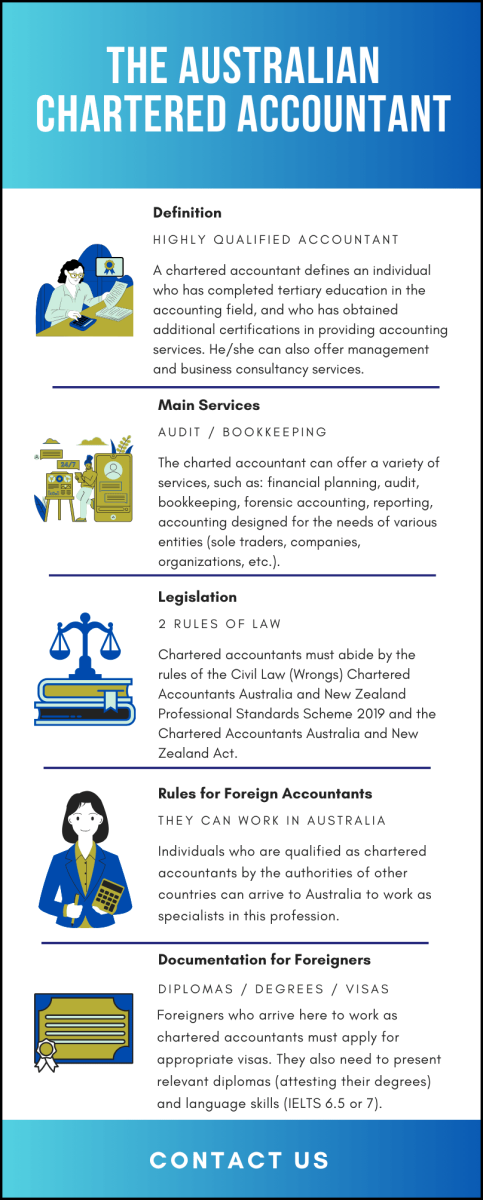
The infographic below presents information on the Australian chartered accountant:
What is the accounting year in Australia?
In Australia, the accounting year is the financial year, which starts on 1st of July and ends on 30th of June. This is the standard financial year, which is followed by most of companies and reporting is done in accordance with this timeframe.
What are the main financial documents that must be prepared by accountants?
In the list below, we present some of the basic documents all companies must prepare and submit to the Australian Taxation Office (ATO):
- the Single Touch Payroll;
- the Business Activity Statement;
- the income tax return;
- the Fringe Benefits return;
- the Pay As You Go withholding annual report;
- the taxable payments annual report;
- the GST annual return.
When are companies required to submit their financial documents?
It depends on the nature of the entity and the type of document that must be submitted. In the list below, our specialists in company formation in Australia present some of the most important deadlines for the submission of accounting documents:
- 30 June – it represents the date when the accounting period is closed, as this is the end of the financial year;
- 28 July – the submission of the GST activity statement;
- 30 September – the submission of financial reports for disclosing entities;
- 31 October – the submission of financial reports for all other entities.
Is it possible to follow a different financial year?
Yes. Companies operating in Australia can request to follow a different financial year (such as the calendar year, which is the standard practice in most countries, such as the ones in Europe).
For more details, our team of consultants in company formation in Australia remains at your service.